

Rotator Cuff Injury Rehab for Overhead Athletes
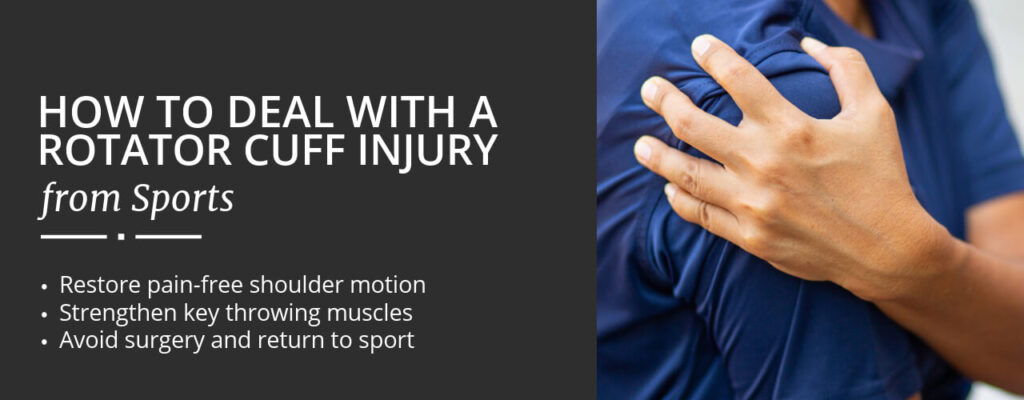
Rotator cuff injury recovery looks different for overhead athletes — and it demands a more targeted approach than standard shoulder rehab. Baseball pitchers, quarterbacks, swimmers, and volleyball players place enormous repetitive stress on the shoulder joint. When the rotator cuff breaks down, the consequences affect performance, confidence, and long-term health. The good news: most rotator cuff injuries respond extremely well to physical therapy, without surgery.
Why Overhead Athletes Are at Higher Risk
The rotator cuff is a group of four muscles — the supraspinatus, infraspinatus, teres minor, and subscapularis — that stabilize the shoulder joint and control arm rotation. In overhead sports, these muscles fire repeatedly at high speed and force. Over time, that repetitive load leads to micro-damage, inflammation, and eventually injury.
Additionally, poor mechanics, muscle imbalances, and postural habits accelerate this process. A baseball pitcher with a forward shoulder posture dramatically increases stress on the supraspinatus with every throw. According to the American Physical Therapy Association, early intervention for shoulder injuries significantly reduces recovery time and lowers the risk of surgical intervention. A swimmer with weak scapular muscles compensates with excessive shoulder movement — grinding the joint with every stroke.
Common overhead sports where these injuries occur include:
- Baseball and softball — especially pitchers and catchers
- Football — quarterbacks and wide receivers
- Swimming — freestyle, butterfly, and backstroke athletes
- Volleyball — hitters and servers
- Tennis and racquet sports — serving and overhead stroke athletes
- Water polo and lacrosse — any repeated overhead throwing motion
Warning Signs You Shouldn’t Push Through
Not every shoulder injury feels the same. However, these are the red flags that signal something is wrong with the rotator cuff:
- Aching pain in the front or side of the shoulder during or after activity
- Weakness when lifting the arm overhead or rotating outward
- A catching, clicking, or painful arc of motion between 60–120 degrees of elevation
- Night pain — particularly when lying on the affected shoulder
- Decreased throwing velocity, stroke power, or serve speed
- Compensating with the neck, trunk, or opposite shoulder to get through reps
Many athletes push through these symptoms for weeks or months. As a result, what starts as manageable soreness becomes a more serious structural problem. Research published by the National Institutes of Health confirms that delayed treatment of rotator cuff injuries is associated with greater muscle atrophy and worse long-term outcomes. Early intervention nearly always means a shorter, simpler recovery.
What Rotator Cuff Injury Recovery Actually Involves
A physical therapy program addresses not just the painful shoulder, but the entire chain of factors driving the injury. For overhead athletes, this typically unfolds across four phases.
Getting Pain Under Control First
The first priority is settling the inflammation and restoring pain-free movement. Manual therapy techniques reduce muscle tightness and improve joint mobility. Gentle range-of-motion exercises rebuild movement gradually, without stressing the injured tissue. Athletes also learn activity modifications to protect the shoulder between sessions.
Building Shoulder Strength and Stability
Once pain is under control, targeted strengthening begins. Rotator cuff exercises are progressed carefully — starting with low-load, high-control movements and building intensity as tolerance improves. Equally important is training the muscles that stabilize the scapula (shoulder blade). Weak scapular muscles are one of the most common — and most overlooked — contributors to overhead shoulder injuries. Without a stable base, the shoulder cannot function properly.
Fixing Posture and Movement Patterns
Forward shoulder posture and a rounded upper back are extremely common in overhead athletes, especially younger ones. This posture compresses the structures inside the shoulder with every overhead motion. During this phase, therapists work on thoracic spine mobility, shoulder alignment, and motor control — retraining movement patterns so the athlete moves efficiently and without compensation.
The Bridge Back to Full Competition
The final phase connects rehabilitation to sport. For a baseball pitcher, this means a structured return-to-throwing program with progressive distance, intensity, and volume. For a swimmer, it means graduated return to yardage with stroke technique monitoring. For a quarterback, it means reintroducing overhead loads with attention to mechanics under fatigue. Therapists monitor closely until full competition is cleared.
How Long Does Recovery Take?
Timelines vary based on injury severity and how long symptoms went untreated:
| Injury Severity | Typical PT Timeline |
|---|---|
| Mild strain | 4–6 weeks |
| Moderate tendinopathy or partial tear | 8–12 weeks |
| Post-surgical repair | 4–6 months |
Most athletes who begin physical therapy early recover faster and more completely. However, even athletes dealing with long-standing shoulder problems can make significant gains with the right program.
Don’t Let Shoulder Pain Sideline You
Playing through pain doesn’t just risk this season — it risks every season after it. Rotator cuff injury recovery works best when it starts early, follows a structured progression, and addresses root causes rather than just symptoms.
Physical therapy gives overhead athletes a clear, evidence-based path back to full performance — without surgery, and without guessing. If your shoulder is holding back your game, now is the time to act.
Contact us today to schedule a shoulder evaluation and get back to doing what you love.