
Pre-Season ACL Injury Risk Reduction: A Data‑Driven Approach for Athletes
ACL injuries are among the most challenging setbacks an athlete can face. While no program can guarantee prevention, the right combination of strength training, movement quality, neuromuscular control, and individualized data can significantly reduce your risk.
At St. Pete Physical Therapy, our sports physical therapists and performance specialists integrate clinical expertise with high-level technology — including VALD ForceDecks force plates and the VALD ForceFrame — to measure exactly how your body produces and absorbs force. This gives us objective data to guide your training, address imbalances, and build a program uniquely tailored to your needs.
To learn more about our integrated model, visit our Sports Physical Therapy page.
Your pre-season is the ideal time to establish this foundation. Below is a comprehensive checklist built around the evidence-based process we use with our athletes to reduce ACL injury risk while enhancing performance.
Pre-Season ACL Injury Risk Reduction Checklist
1. Begin With a Comprehensive Movement & Strength Assessment
Before adding volume, intensity, or velocity to your training, it’s essential to understand how your body currently moves and how well you can produce and withstand force.
What This Means at St. Pete Physical Therapy
- Full movement screen led by a sports physical therapist
- Force plate jump testing (VALD ForceDecks) for symmetry, landing forces, and power outputs
- Strength testing with VALD ForceFrame to measure hamstring, quad, hip, and trunk strength
- Custom training plan based entirely on your data
This ensures your program is precision‑built — not based on guesswork.
2. Prioritize Hamstring and Glute Strength
The ACL is most vulnerable when the posterior chain is underdeveloped. Improving hamstring and glute strength enhances knee stability during acceleration, sprinting, landing, and cutting.
How We Build It
- Targeted posterior-chain strengthening
- Data-driven load progressions using your VALD test results
- Emphasis on symmetry, control, and sport-specific movement patterns
When your posterior chain is strong, your knee is far safer under stress.
3. Develop Dynamic Core Stability
Your core controls trunk positioning — a major factor in reducing knee valgus stress, especially during single-leg loading.
Expect to Train
- Rotational strength
- Anti-rotation and anti-flexion training
- Core engagement integrated into squats, jumps, and change‑of‑direction drills
A stable trunk means a more stable knee.
4. Reinforce Safe Landing Mechanics
Improving how you absorb impact is one of the most effective ways to reduce ACL injury risk.
Our Training Emphasis
- Knee tracking aligned with toes
- Soft, controlled landing patterns
- Double- and single-leg landing progressions
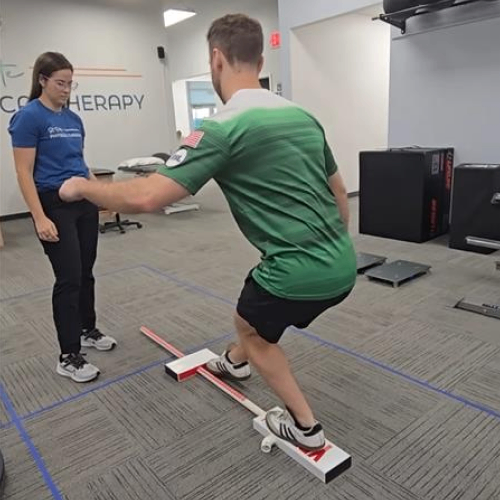
- Force plate feedback to analyze landing asymmetries and braking forces
We teach your body how to accept force before we ask it to produce more.
5. Train Controlled Change-of-Direction and Deceleration
Many ACL injuries occur during deceleration or cutting — especially when knee alignment breaks down at high speed.
You Will Practice
- Hip-driven cutting mechanics
- Proper deceleration patterns
- Avoiding knee valgus collapse
- Progressive speed work once technique is efficient
This improves both safety and performance.
6. Add Balance and Proprioception Training
These drills sharpen your joint awareness and reactive stability — critical for unpredictable sport environments.
We Use
- Single-leg stability challenges
- Reaction and perturbation drills
- Dynamic balance integrated with movement tasks
Better joint awareness = safer movement under pressure.
7. Incorporate Plyometrics With Intention
Plyometrics build explosiveness, but must be introduced at the right time and volume.
Our Plyometric Process
- Start with low-intensity jumps
- Emphasize perfect landings over rep count
- Use force plate data to track power, asymmetry, and fatigue
Your power training becomes both safe and measurable.
8. Prioritize Mobility Every Session
Tightness in the hips, quads, or calves changes force distribution and increases knee strain.
Expect
- Dynamic mobility in warmups
- Soft tissue or foam rolling interventions
- Targeted mobility based on your assessment findings
Good mobility creates efficient, safe movement patterns.
9. Monitor Training Load and Recovery
Overtraining is one of the clearest predictors of injury. Recovery is part of performance.
Our Approach
- Guidance on weekly training volume
- Structured rest or taper days
- Program adjustments based on soreness, fatigue, or force plate findings
We help you train smarter, not just harder.
Consistency + Data = Reduced Injury Risk
Reducing ACL injury risk isn’t about doing one exercise or one screening — it’s about consistent, targeted effort built on accurate information. Your preseason establishes the foundation, but the habits and data-driven progressions carry you through the full competitive year.
At St. Pete Physical Therapy, our unique model combines:
- Sports physical therapy
- Performance strength & conditioning
- Movement analysis
- VALD force plate and ForceFrame testing
to help athletes move better, get stronger, and compete with confidence.
Train Smart. Play Confident. Stay in the Game.
Whether you’re preparing for high school, college, or competitive adult leagues, the smartest athletes train with intention — not guesswork.
Let our team guide your preseason and reduce your risk of injury with a customized, data-backed ACL program.
👉 Schedule your preseason performance evaluation at St. Pete Physical Therapy today.
Your best, safest season starts with the right plan.