Chronic knee pain treatment starts with one honest question: how long have you been telling yourself this would go away on its own? Six weeks? Six months? Two seasons?
You have already tried the internet’s advice. You rested. You bought the sleeve. You stretched your quads and iced after every run. However, the pain still shows up on stair three, or at mile four, or the morning after every game.
Here is what most athletes never hear. Persistent knee pain is rarely a knee problem alone. Furthermore, it almost never resolves with rest by itself. Therefore, this article breaks down the five myths we hear most often in our St. Petersburg clinic, and shows you what real recovery actually looks like.
Why Chronic Knee Pain Sticks Around
Acute pain is a signal that tissue got overloaded. Chronic pain is different. After weeks or months, the knee is no longer just irritated. Instead, the muscles around it have weakened, your movement patterns have shifted, and your body has quietly built a new way of walking, squatting, and landing that protects the joint.
That protection is the trap. As a result, the quad on your painful side gets weaker, your hip stops controlling the knee, and the joint takes more load with less support. Consequently, every return to sport reloads a system that nobody ever rebuilt.
Rest calms the symptom. It does not rebuild the system. For that reason, effective chronic knee pain treatment has to change the machine around the joint, not just quiet the joint down.
5 Myths That Keep Athletes in Pain
Myth 1: “I just need to rest it.”
Short rest during a flare-up helps. Long rest does damage. In fact, within two weeks of reduced activity, your quadriceps start losing strength and size, and the knee loses its primary shock absorber.
For example, we regularly see runners who took a full month off. They come back at their old mileage, feel great for three runs, then crash. Nothing healed. They just got weaker in a quiet way.
Movement, dosed correctly, is treatment. Total rest is a pause button.
Myth 2: “Surgery is the only real fix.”
Sometimes surgery is right. Often it is not. Additionally, research on knee osteoarthritis and degenerative meniscus tears has repeatedly shown that structured exercise therapy, the backbone of chronic knee pain treatment, produces outcomes comparable to arthroscopic surgery for many patients.
In practice, we build strength first and reassess. As a result, many athletes never need the operating room. Others go into surgery stronger, and recover faster because of it.
Myth 3: “It’s just runner’s knee. Everyone gets it.”
Runner’s knee is a symptom description, not a diagnosis. Meanwhile, the actual driver could be weak hip abductors, a cadence problem, a training spike, an old ankle sprain that changed how you land, or true cartilage irritation under the kneecap.
Therefore, the same knee pain in two athletes can require two completely different plans. A label is not a cause.
Myth 4: “Exercise will make it worse.”
Loading a painful knee correctly is how it gets stronger. However, “correctly” matters. For instance, we use a simple rule with athletes: pain during exercise should stay at or below 3 out of 10, and it should settle back to baseline within 24 hours.
If it does, that load is working. If it does not, we adjust the dose instead of abandoning the exercise.
Myth 5: “I can push through until the season ends.”
This is the one that costs athletes the most. Pushing through changes how you move. Subsequently, you compensate, overload the other leg, and turn a six-week problem into a six-month one.
For example, a high school soccer player who limps through the second half is training that limp. Every rep of it. You are not being tough. You are practicing a bad pattern.
What Chronic Knee Pain Treatment Actually Looks Like
At St Pete Physical Therapy, we do not hand you a sheet of generic exercises. Instead, we find out why the knee is failing, and then we rebuild it for the demands of your sport.
Real chronic knee pain treatment includes:
- A real evaluation. We test strength side to side, and we watch you squat, step down, land, and run. Consequently, we find the weak link, not just the sore spot.
- Hands-on work. Manual therapy restores the motion your joint has lost, so you can actually train the muscle around it.
- Progressive strengthening. Quads, glutes, hamstrings, and calves, loaded heavy enough to change something. Light band work alone will not do it.
- Movement retraining. Gait, cadence, and landing mechanics, because how you load the knee matters as much as how strong it is.
- Return-to-sport criteria. We do not clear you by the calendar. Instead, you get cleared by the tests.
Those criteria are concrete. As an example, before we return a runner to full mileage, we want less than a 10 percent strength difference between legs, 20 single-leg step-downs without pain, and a single-leg hop distance within 90 percent of the other side.
Most athletes we treat feel meaningful change in 4 to 6 weeks, and reach full return to sport in 8 to 12. Of course, your timeline depends on how long the pain has been there, what caused it, and how consistently you do the work.
When You Should Get It Checked Right Away
Some knee symptoms are not a training problem. Book an evaluation soon, or see a physician, if you have:
- A knee that locks, catches, or gives way underneath you
- Significant swelling that appears within hours of an injury
- Inability to put weight through the leg
- Pain that wakes you at night
- Redness, warmth, or fever along with the knee pain
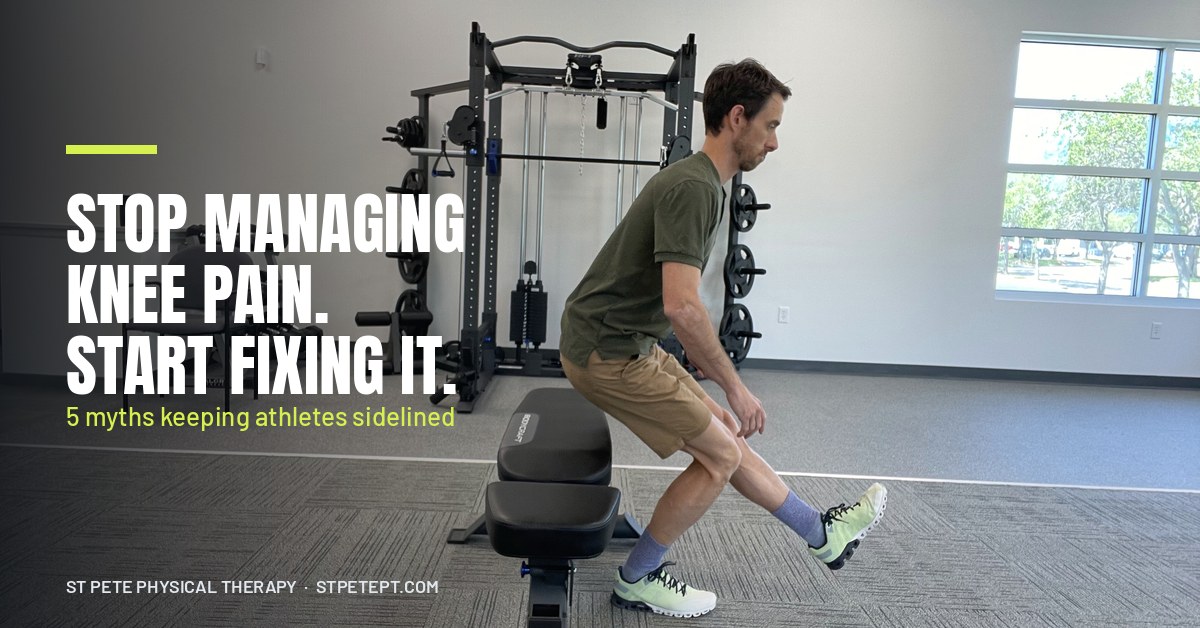
Stop Managing It. Start Fixing It.
Chronic knee pain is not a life sentence, and it is not something you outgrow, outrest, or out-tough. Effective chronic knee pain treatment finds the cause, rebuilds the strength you lost, and returns you to your sport with criteria you can actually trust.
You have already given this thing months. In return, give us four to six weeks.
Our sports physical therapy team in St. Petersburg treats runners, high school and college athletes, and weekend warriors who are tired of hearing that they just need to rest. So call 727-490-9487 or book an evaluation at stpetept.com, and let us get you back on the field.