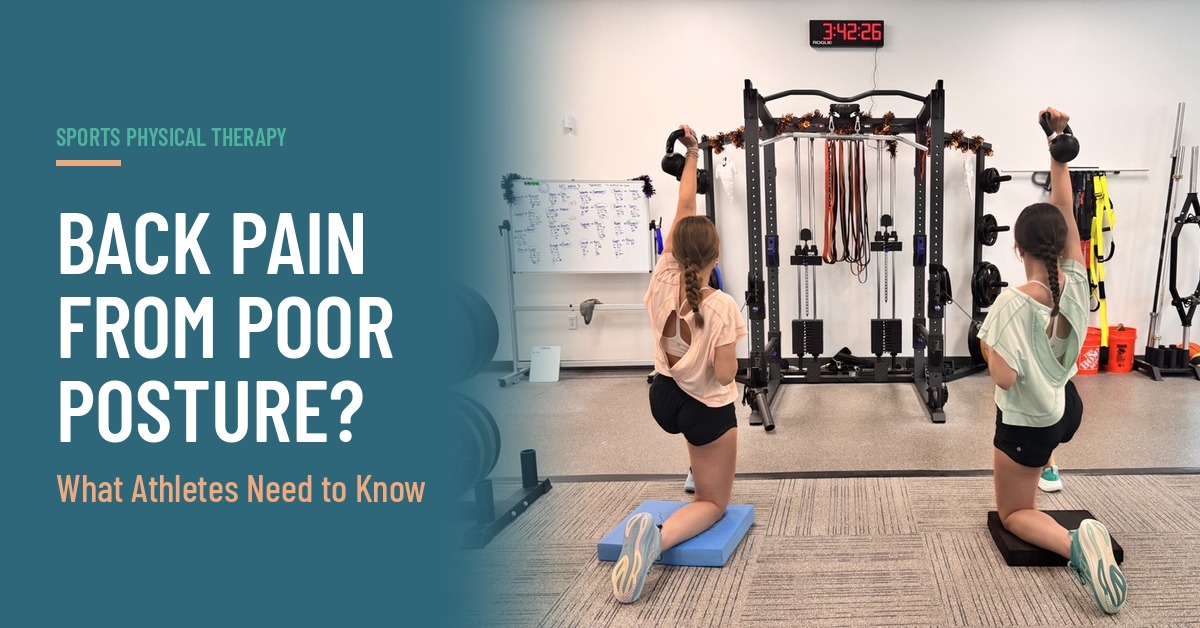
Back pain from poor posture usually gets the same advice: sit up straight, pull your shoulders back, stretch more. For athletes, that advice rarely fixes it.
For example, think about a normal day. You sit through six hours of class or a full workday. Then you train. Then you’re hunched over a laptop again at 9 p.m. Somewhere in there, your low back or the area between your shoulder blades starts to ache.
This post covers what actually drives that ache, the warning signs that mean it’s something else, and how physical therapy gets you back to training without it.
Is Your Back Pain From Poor Posture?
Partly, maybe. However, research has not found a single “correct” posture that prevents back pain. In fact, spinal curves vary naturally from person to person, and people sit and stand in a wide range of positions without any pain at all. A 2019 paper in the Journal of Orthopaedic & Sports Physical Therapy reviewed this evidence and reached the same conclusion.
Instead, two things usually matter more:
- Time in one position. Any posture gets uncomfortable if you hold it long enough, even “perfect” posture.
- Capacity. This is whether your back, hips, and trunk are strong enough for everything you ask of them: school or work, plus practice, plus lifting, plus games.
In short, your best posture is your next one. The goal is not to hold a perfect position. The goal is to move often and build a back that tolerates any position.
Why Athletes Get Back Pain From Poor Posture
After all, athletes don’t just sit. They load the spine hard, and then they sit on top of it. In the clinic, we see the same patterns over and over:
- Cyclists and triathletes who spend hours bent forward on the bike, then sit at a desk all day
- Swimmers, gymnasts, volleyball players, and dancers who arch backward again and again
- Catchers, rowers, and golfers who hold or repeat the same rounded or rotated position
- Students who add a heavy backpack and long homework sessions to a full practice schedule
- Lifters who ramped up their training volume too quickly
In each case, the total load has outpaced what the back is prepared to handle. As a result, the back gets irritated. In other words, posture is part of that picture, but it is rarely the cause on its own.
The fix is usually more strength and more variety, not a stiffer, straighter spine.
Red Flags: When It’s Not a Posture Problem
Not every case of back pain from poor posture is really about posture. Some back pain needs an evaluation before you train through it. Get checked if you notice any of the following:
- A teen athlete with low back pain that gets worse when arching backward. This is common in gymnastics, football, volleyball, and diving. It can point to spondylolysis, a stress fracture in the low back.
- Pain, numbness, or tingling that travels down the leg
- Weakness in the leg or foot
- Pain that wakes you at night or does not change with position
- Pain that started after a fall, hit, or crash
- Changes in bowel or bladder control, or numbness in the groin. Seek medical care right away.
If any of these sound familiar, don’t wait it out. A physical therapist can evaluate you and refer you to a physician if you need imaging or further care.
How Physical Therapy Treats Back Pain From Poor Posture
At St. Pete Physical Therapy, we treat this as a training problem, not just a posture problem. Here is what that looks like.
- A full evaluation, not just a posture check. We look at how you move, where you’re strong, where you’re not, and how your week is loaded. That includes class or desk time, practice, lifting, and competition. Together, this tells us what is actually driving the pain. (See how we approach back pain relief.)
- Calm it down without shutting you down. In most cases, athletes don’t need full rest. Instead, we adjust volume and positions in the short term so you can keep training. Hands-on treatment can also reduce pain and stiffness enough to get you moving.
- Build capacity. In fact, this is the core of the plan. You’ll do progressive strength work for the trunk, hips, and upper back. Think hip hinges, carries, rows, and back extensions, loaded and progressed over time. We also use objective strength testing, so your progress is measured instead of guessed.
- Rebuild tolerance to the position that hurts. Maybe it’s riding in the drops, holding a catcher’s crouch, or arching to hit a spike. Either way, we reintroduce that position gradually instead of avoiding it.
- Return to full training. You go back to your full schedule with a plan for managing load when school, the season, or race prep ramps up.
Expect some change within a few weeks, but real strength gains take longer. For most athletes, that means at least six to eight weeks of consistent work. Overall, your timeline depends on how long the pain has been there and what your sport demands.
What You Can Start Today
You don’t need to wait for an appointment to start easing back pain from poor posture. For example:
- Move more often. Above all, change positions regularly through the school or work day. Stand up, walk between classes, and switch how you sit.
- Stop chasing “perfect.” Sitting with a rounded back is not dangerous. Instead, use whatever position is comfortable. Just don’t stay there for hours.
- Strength train two to three days per week. A simple starting point is a hip hinge, a side plank, a row, and a loaded carry. Start light, and then build gradually.
- Watch your total load. If your back flares when practice, lifting, and game days stack up, that’s a scheduling problem as much as a back problem.
- Don’t try to stretch your way out of it. Stretching may feel good in the moment. However, it does not build the strength your back needs.
Get Back to Training Without the Ache
Here are the key takeaways:
- Back pain from poor posture is rarely about posture alone. Time in one position and low capacity usually drive it.
- There is no single correct posture. Your next posture is your best posture.
- Strength, load management, and gradual exposure fix it. Sitting taller and stretching usually don’t.
- Red flags, such as leg symptoms or back pain with arching in teen athletes, need an evaluation.
Whether you’re a high school athlete in St. Pete or a masters cyclist logging miles on the Pinellas Trail, you don’t have to train around a sore back. Book an evaluation with St. Pete Physical Therapy or call 727-490-9487 to get a plan built around your sport.