You reach back to check your blind spot and your neck locks up. You get under the bar for overhead press and the third rep lights up the right side. Or you wake at 3 a.m. because no pillow position works anymore.
Physical therapy for neck pain works, but only when it goes after the reason your neck is irritated instead of chasing the spot that hurts. Below is what real treatment looks like, the test we use to know you’re actually getting stronger, how long it honestly takes, and the symptoms that mean you should get checked now.
Posture Gets Too Much of the Blame
Posture is part of the picture, not the whole thing. Adults with neck pain do tend to sit with the head further forward than people without it. However, that research is a snapshot. It can’t tell you whether the posture caused the pain or the pain changed the posture. In teenagers, the link mostly disappears.
What we find more consistently is a capacity problem. The deep muscles at the front of your neck, called the deep neck flexors, are the ones that let you nod without jutting your chin. When they fatigue early, bigger surface muscles like your upper traps take over and stay switched on far longer than they should.
Load history matters more than posture. For example, most lifters and swimmers we see added volume, changed a grip, or started a new program two to four weeks before the neck started talking.
Your neck hurts because it’s doing more work than it can currently handle. The fix is raising what it can handle.
What Physical Therapy for Neck Pain Actually Involves
Physical therapy for neck pain runs in three phases. They overlap, and you don’t wait for one to be perfect before starting the next.
Phase 1: Calm It Down (Weeks 1–2)
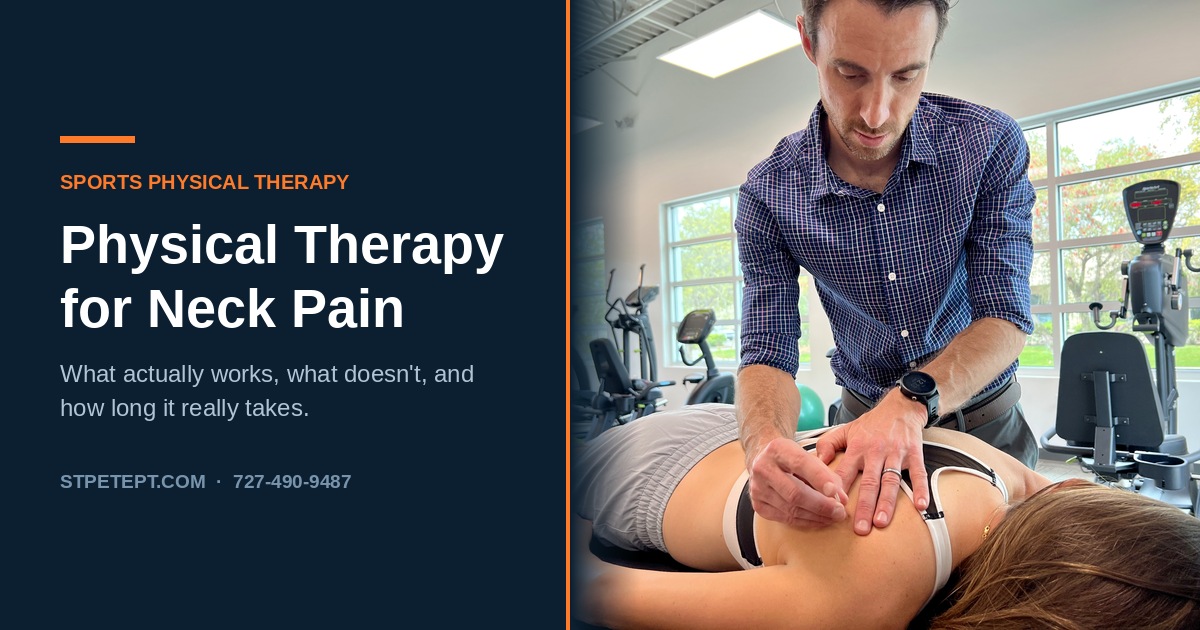
Physical therapy for neck pain starts here, by reducing the irritation so you can move. That means hands-on work to the stiff segments and the guarding muscles, gentle rotation and side-bend drills done often rather than hard, and a short list of training modifications. Not a shutdown.
Additionally, we look at what’s feeding it: your sleep position, your desk setup, and the specific lift or stroke that flares it.
You should feel a meaningful difference in the first two weeks. If nothing changes, the plan changes.
Phase 2: Get the Motion Back
Next we restore rotation and extension. We compare left to right, because most people with a cranky neck have quietly lost motion turning one direction and stopped noticing.
Joint mobilization, mid-back mobility work, and breathing drills do most of the lifting here. Your mid-back matters more than people expect. If it won’t extend, your neck extends for it. The research on mid-back treatment for neck pain is promising rather than settled, but in practice it’s one of the fastest ways we get rotation back.
A neck that turns evenly in both directions is the checkpoint before we add real load.
Phase 3: Build Capacity
This is the phase most people skip, and it’s why neck pain keeps coming back.
We test deep neck flexor endurance directly. Lie on your back, tuck your chin gently, lift your head an inch off the floor, and hold. Healthy adults average around 39 seconds for men and 29 for women. People with neck pain average closer to 24. If you’re shaking at 15 seconds, that’s useful information, not a character flaw.
From there it’s progressive work: isometric holds in all four directions, upper back and scapular strengthening, and loaded carries. Carries are underrated. Furthermore, they train your neck and shoulder girdle to hold position under fatigue, which is exactly what sport demands.
Strength is the part of physical therapy for neck pain that we count on to make the relief stick.
The Mistake We See Every Week
Stretch the upper trap. Massage gun. Repeat.
It feels good for twenty minutes, so it feels like progress. However, the measurable problem in long-standing neck pain isn’t muscle length. It’s timing and duration. Those surface muscles switch on early, stay on too long, and are slow to shut off — and the worse the pain, the longer they stay on. Stretching doesn’t change any of that.
Physical therapy for neck pain should replace that cycle, not add another tool to it. Stretch if it feels good. Just don’t confuse it with treatment.
If relief lasts less than an hour, you need strength, not more mobility.
How Long Neck Pain Takes to Resolve
Here’s the honest version, and it’s less rosy than most clinic blogs will tell you.
Most improvement happens in the first 6 to 12 weeks. After that, progress slows considerably, and after a year it’s slower still. That’s the pattern in the research, and it’s the pattern we see in the clinic.
- Recent, mechanical neck pain: expect meaningful change in the first few weeks, with pain typically dropping by roughly half around the six-week mark.
- Recurrence is the real issue: somewhere between half and 85 percent of people have another episode within five years, and about a third have symptoms that persist past a year.
- Symptoms running into the arm: substantially slower. Most people improve, but the bulk of that improvement lands in the four-to-six-month window, not the four-to-six-week window.
Physical therapy for neck pain isn’t a one-visit fix, and this is why we push the strength phase so hard. Feeling better at week six is common. Still feeling better at month twelve is the part that takes work.
When to Get Evaluated Right Away
Most neck pain is mechanical and safe to work through. Some isn’t. Get evaluated promptly if you have:
- Numbness, tingling, or weakness in your arm or hand
- Neck pain after a collision, fall, or head impact
- A stinger — burning down one arm after contact — especially if it repeats or lasts more than 24 hours
- Trouble with fine motor tasks like handwriting or buttoning a shirt, or new balance and coordination problems
- Pain that wakes you every night regardless of position
- Headaches with dizziness or visual changes
- Fever, unexplained weight loss, or a cancer history alongside new neck pain
These are reasons to be evaluated, not diagnoses. Don’t sit on them.
A note for contact-sport families: stingers are common, and that’s exactly why they get ignored. Half of football players report at least one in their career, and recurrence is high. Most resolve within a day. One that doesn’t is worth imaging.
Getting Back to Training Without Restarting the Clock
Return to sport is a load problem, not a pain problem. Consequently, physical therapy for neck pain has to include a plan for your sport, not just a plan for your symptoms. We rebuild in order: unloaded motion, then isometrics, then light pressing and overhead work, then speed and contact.
Here in St. Petersburg we see a lot of year-round athletes. Swimmers, triathletes, and high school kids playing two sports at once, where resting for a month isn’t a real option. So we modify instead. Drop overhead pressing, keep pulling. Shorten the swim sets, keep the aerobic work. Meanwhile, the neck stays loaded the whole time, just differently.
The goal isn’t a pain-free week off. It’s a neck that handles your sport in week ten.
The Short Version
- Capacity matters more than posture, and load history usually explains the flare
- Hands-on care buys you room to move; strength is what we count on to keep it gone
- Test it: a chin-tuck hold near 30 seconds, and even rotation both directions
- Good physical therapy for neck pain treats the driver, not the sore spot
- Most of your progress happens in the first 6 to 12 weeks, so use them
- Arm numbness, weakness, or pain after contact means get it looked at now
If your neck is limiting your training, your sleep, or your workday, physical therapy for neck pain can get you moving again and keep you there. Our team at St Pete Physical Therapy will find the actual driver and build the plan around your sport, not around a generic protocol.
Book an evaluation at stpetept.com or call 727-490-9487.