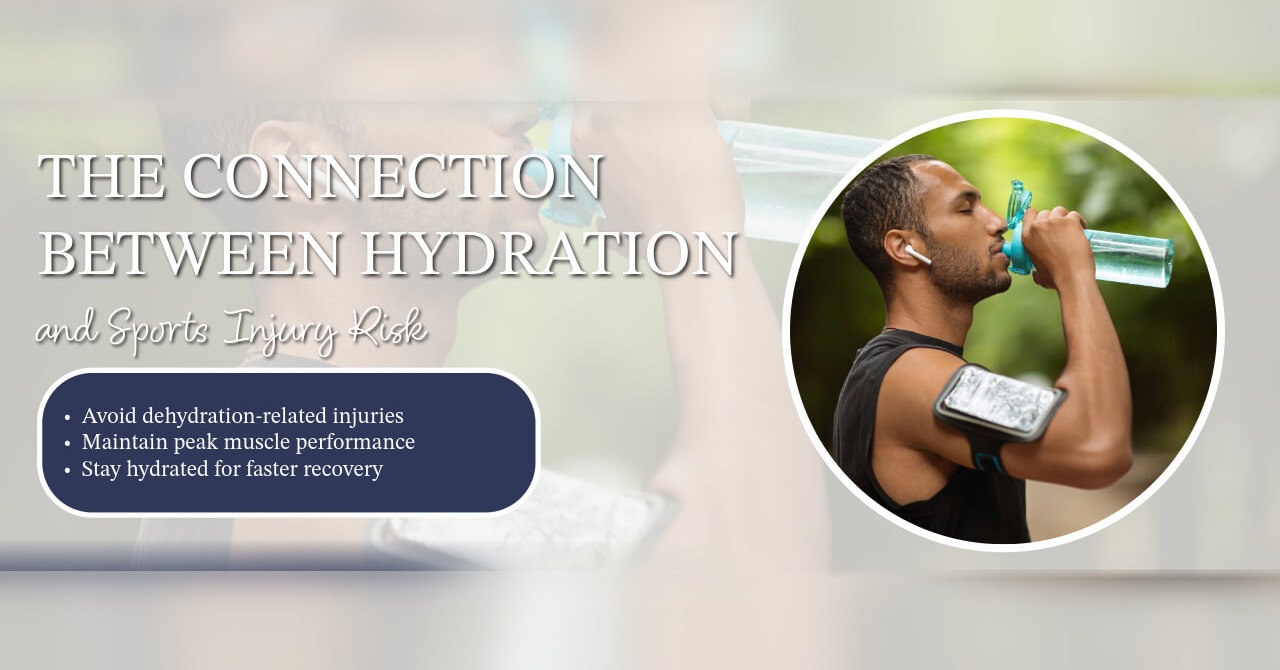
You cramp up late in the fourth quarter. You tweak a hamstring on a sprint you’ve done a thousand times. You feel a half-step slow and can’t say why. Before you blame your training, look at your water bottle. Hydration and injury prevention are tied together far more tightly than most athletes realize, and dehydration is one of the most common and most fixable risk factors we see. Below, we answer the questions athletes ask us most, so you understand how fluids affect your muscles, your movement, and your odds of staying on the field.
How does dehydration increase your injury risk?
It starts with your blood. Dehydration lowers your blood volume, which means less oxygen and fewer nutrients reach your working muscles. As a result, those muscles fatigue faster and lose their ability to absorb and control force.
That’s where the trouble begins. A tired muscle is a sloppy muscle. Your coordination slips, your form breaks down, and one leg starts quietly picking up the slack for the other. This is the exact chain we watch play out with athletes who fade in the second half of a game or the back end of a long run. The strain rarely happens on the first rep. It happens on the hundredth, when fatigue has stacked up and control is gone.
However, don’t overstate the plumbing. The strongest, best-supported link between dehydration and injury is fatigue and lost coordination, not a sudden shortage of joint fluid. Fix the fatigue side and you address the part that actually protects you.
Can hydration affect recovery after an injury?
Yes, and this is the part most athletes skip. Every repair process in your body runs on fluid. Circulation clears metabolic waste out of damaged tissue and carries oxygen and nutrients back in. Run that system dry and everything slows down.
When we build return-to-sport plans for athletes coming back from a hamstring strain or a sprained ankle, hydration is part of the conversation, right alongside load and tissue tolerance. It won’t heal you on its own. But chronic under-hydration is a quiet tax on recovery you don’t need to pay.
Early signs dehydration is raising your injury risk
Most athletes don’t notice dehydration until it costs them something. Watch for these:
- Cramping that keeps showing up in the same muscle
- Soreness that lingers longer than it used to
- Fatigue that hits earlier in training than it should
- Balance or coordination that feels off
- Dizziness or lightheadedness after hard efforts
One of these on a hot day is normal. Several of them, showing up week after week, is a pattern worth taking seriously. If that sounds like you, dehydration may be one piece, and a movement assessment can sort out how fatigue, hydration, and your mechanics are interacting.
Does hydration affect flexibility and mobility?
Somewhat. When you’re dehydrated, muscles tend to feel stiffer and less pliable, so your working range of motion can shrink. Move through a smaller range for long enough and your body starts finding compensations elsewhere, which is a common setup for overuse injuries.
That said, keep this in perspective. Water is not a substitute for mobility work. Staying hydrated keeps your tissue from feeling needlessly tight, but it’s your warm-up and your training that build real range.
How much should you drink to reduce injury risk?
Your needs shift with your body, your sport, the heat, and how much you sweat, which in a Tampa Bay summer is a lot. The National Athletic Trainers’ Association hydration guidelines make the same point: fluid needs are individual, and the best plans are built around your own sweat rate. The core principle is simple: drink steadily across the whole day, not in a panicked gulp before practice.
- Drink 16 to 20 ounces of water 2 to 3 hours before training
- Sip fluids at regular intervals during exercise rather than waiting until you’re thirsty
- Rehydrate afterward, adding electrolytes if the session was long or sweaty
The best check you own is free: look at your urine. Pale yellow means you’re on track. Dark and you’re already behind. Thirst is a late alarm, not an early one, so don’t use it as your only guide.
Do you need sports drinks?
Usually not. For most workouts under an hour, water does the job. The electrolytes matter once you push past that, especially in the heat, when you’re losing real sodium and potassium through sweat that plain water won’t replace.
Be honest about the sugar, though. A lot of what gets sold as a sports drink is closer to soda, and you don’t need it for a 45-minute session. Match the drink to the demand: water for the short stuff, electrolytes for the long, hot, sweaty efforts that actually earn them.
Hydration and Injury Prevention: What We Do in the Clinic
Here’s the honest version. Hydration won’t prevent every injury, and any program that sells it as a magic fix is overselling. What it does is remove one avoidable variable that quietly makes everything else worse.
So when we assess an athlete, we look at the whole picture: how fatigue, coordination, strength, and joint mechanics fit together, with hydration as one input among several. It sits inside a real plan next to strength work, mobility, and technique, not off on its own. When someone is stalling in recovery or breaking down late in games, hydration habits are one of the first simple things we check — because they’re so easy to fix.
The bottom line
Hydration and injury prevention come down to a few honest points:
- Dehydration mostly hurts you through fatigue and lost coordination, and that’s exactly where injuries start
- Steady, all-day drinking beats last-minute chugging every time
- Water covers most sessions; save electrolytes for the long, hot ones
- It’s one piece of the puzzle, not the whole thing, but it’s one of the easiest to get right
Nagging injuries or a step you’ve lost often have more than one cause, and hydration is a cheap place to start ruling things out. If you keep breaking down and want to know why, the team at St Pete Physical Therapy can put the whole picture together and build you a plan to get back on the field. Book an evaluation at stpetept.com or call 727-490-9487.